
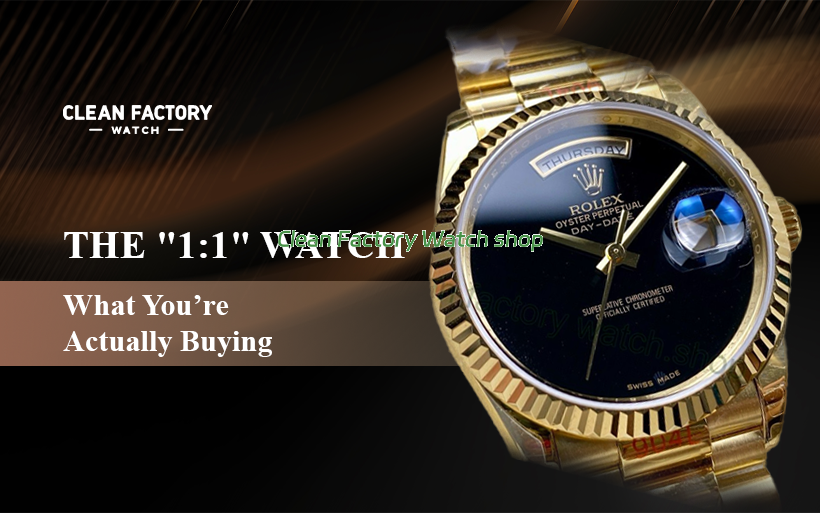
If you’ve spent more than five minutes browsing replica forums or Telegram catalogs, you’ve seen it: “Best 1:1 Version,” “Perfect Clone,” “Original 1:1 Quality.” It’s a catchy hook. It’s comforting. And in many cases, it’s a complete fabrication.
The replica watch market is a wild frontier of engineering, high-stakes supply chains, and, unfortunately, a fair amount of smoke and mirrors. For a newcomer, the “1:1” label feels like a guarantee. For a seasoned collector, it’s a red flag that requires further investigation. To buy a high-end timepiece that actually holds up to scrutiny, you have to look past the marketing slogans and understand the mechanical reality of what’s on your wrist.
What Does “1:1” Actually Mean?
In a perfect world, a 1:1 replica would be a watch where every single component—from the hairspring to the oscillating weight—is interchangeable with the genuine counterpart. In the real world, “1:1” is an industry-standard shorthand for “it looks very close to the original in a photo.”
True high-end replicas, often referred to as Super Clones or N-tier versions, aren’t just about the face. They focus on the architecture. This includes accurate case proportions (measured to the micron), proper weight distribution (using tungsten or high-density steel), and “integrated” movements that mirror the aesthetic and function of the genuine caliber.
The Standard vs. The Reality
| Feature | Market “1:1” Label | True Premium Grade |
| Material | Often 316L Steel | Genuine 904L Stainless Steel |
| Movement | Decorated Plate (looks like the real thing) | Integrated Clone (functions like the real thing) |
| Lume | Standard phosphorescent paint | Swiss Super-LumiNova® Grade |
| Weight | “Feels” heavy | Matched to the gram of the original |
| Waterproofing | Splash resistant | Pressure tested to 5-10 ATM |
However, the term “1:1” isn’t a certified grade. There is no “Replica Board of Standards” checking these watches. It is a sales label. When a seller says “1:1,” they are telling you the watch is a high-effort attempt at replication, but the quality of that effort varies wildly between a $200 entry-level piece and an $800 masterwork.
The Factory Perspective: Why “Original Level” is a Moving Target
Every factory—be it VSF, C+, or BT—claims they have the “Original Level” mold. They promise 904L steel, “full function synchronization,” and “perfect” finishing. But when the watch lands on your doorstep, why do some feel like a luxury item while others feel like a sophisticated toy?
The answer lies in the supply chain. A “factory” in the replica ap watch world is rarely a single building where raw steel goes in one end, and a watch comes out the other. Instead, it’s a decentralized network of specialized workshops. One workshop handles the CNC machining for the cases. Another specializes in ceramic bezels. A third produces the dial. The “Factory” name you see on the website is essentially the entity that handles the final assembly and quality control (QC).
This is why “V2” or “V3” versions exist. A factory might find a better supplier for the hands or a more stable movement for the next batch. The “1:1” goal is an evolution, not a destination.
For those seeking the pinnacle of this evolution, the Clean Factory watch has set the benchmark, particularly with our industry-leading ceramic bezels and movement stability that often outperforms the competition in side-by-side comparisons.
Market Reality: The 20-Level Quality Trap
This is the part most buyers don’t realize: a single popular model, like a Submariner or a Daytona, can have up to 20 different quality levels circulating at once. Because the demand is so high, various workshops produce versions at every conceivable price point.
Breaking Down the Tier System
- Entry-Level ($150–$250): Uses 316L steel, cheap mineral glass, and basic “workhorse” movements (like the DG2813). They look okay from a distance but feel “tinny” and light.
- Mid-Tier ($250–$400): Often uses 904L steel and sapphire crystal. The movements are usually “decorated” (a fake plate glued over a standard movement) to look like the real thing.
- High-End / Super Clone ($450–$900): This is where the 1:1 claim actually starts to hold weight. These feature integrated clone movements (e.g., the VS3135 or DD4130), correct weight structure, and professional-grade finishing.
The danger for the consumer is Information Asymmetry. From a low-resolution photo on a website, a $250 mid-tier watch and a $600 Super Clone look 95% identical. This allows unscrupulous sellers to pass off lower-tier versions as premium stock.
Why “Price Never Lies” (The Math of a Replica)
The best replica watch market is surprisingly efficient. If a seller is offering a “Top Tier” Daytona for $300 while every other reputable dealer is charging $700, they haven’t “found a shortcut.” They are selling you a different watch.
Let’s look at the cost structure. A premium watch price isn’t just the parts; it covers:
- The Component Grade: 904L steel is harder on CNC machines and more expensive to source than 316L.
- The Movement: A Dandong 4130 movement (the gold standard for Daytona clones) can cost the seller hundreds of dollars alone.
- The Risk Reserve: Reputable sellers include a margin for customs seizures and after-sales warranty support.
According to global trade data, the secondary market for luxury goods, including high-end horological replicas, has seen a steady increase of 12% annually (Source: Bain & Company Luxury Report). As the value of genuine luxury watches skyrockets, the investment in high-end replica R&D follows suit. This means the price of the “best” version will always remain high because the technology required to build it is expensive.
When the price is pushed too low, the seller has only two options: cut the service (no QC, no shipping guarantee) or cut the quality (version substitution). Most choose the latter. They send you a version from a cheaper factory that looks similar in photos but will fail within six months.
Seller, Factory, and Customer: The Three Perspectives
Understanding the ecosystem helps you navigate the buy.
- The Factory wants volume. They want to push out 5,000 units and move to the next batch. They don’t care about your specific watch’s lume alignment.
- The Seller (the “Middleman”) is the most important person in your journey. A good seller acts as your Quality Control officer. They reject bad units from the factory so you don’t have to deal with them.
- The Customer wants the best value. But “value” isn’t the lowest price; it’s the highest quality-to-price ratio.
To bridge this gap, collectors often gravitate toward established names known for consistency. The reputation of a Clean Factory watch wasn’t built on low prices, but on the fact that their “1:1” claim is backed by actual engineering that stands up to a loupe.
How to Make a Smart Buying Decision
If you want to walk away with a watch you’re proud of, you have to change your vocabulary. Stop asking “Is this 1:1?” and start asking specific, technical questions.
The Buyer’s Checklist:
- What movement is inside? Ask for the specific caliber (e.g., VR3235 vs. SA3235).
- Is the weight disclosed? High-end replicas of precious metal watches often use tungsten inserts to mimic the weight of gold.
- Are these real QC photos? Ask for a video of the timegrapher (which measures the movement’s health) to ensure it’s running within acceptable tolerances (+/- 5 seconds per day).
- What is the return/seizure policy? A professional seller will have a clear plan for what happens if the watch is lost in transit or seized by customs.
The “Tell” of a Bad Version
If you see a seller using stock photos from the genuine brand’s website, run. If the price is “too good to be true,” it is. If the seller cannot tell you which specific movement is used, they are likely selling a lower-tier version.
The Future of Cloning: AI and Precision Engineering
In the past, you could spot a replica by the “rehaut” alignment or the thickness of the font on the dial. Today, many of these “tells” have been eliminated.
Recent industry surveys suggest that the precision of top-tier replica components has reached a tolerance of 0.01mm (Source: Federation of the Swiss Watch Industry FH). This level of precision makes it almost impossible for anyone but an expert watchmaker with the back removed to tell the difference.
Frequently Asked Questions
- Can a jeweler tell it’s a replica? If it’s a high-end Super Clone, they often cannot tell from the outside. However, once the case back is removed, the movement architecture usually gives it away to a trained eye.
- Why is shipping $40–$60? International shipping for “sensitive” items involves complex routing and insurance to bypass customs risks. You aren’t just paying for postage; you’re paying for a safe arrival.
- Does 904L steel really matter? Yes. While 316L is excellent, 904L has a distinct luster and much higher corrosion resistance, which is why brands like replica Rolex watches use it exclusively.
When you weigh these factors, it becomes clear why certain factories dominate the conversation. A Clean Factory watch remains a top choice for enthusiasts because they prioritize these technical nuances over flashy marketing.
Final Thoughts: Transparency is the New 1:1
The replica watch market is no longer about “faking it.” It has become a hobby for people who appreciate the engineering of luxury watches but refuse to pay the 500% “brand tax” or wait five years on a boutique list.
The secret to a successful purchase is ignoring the “1:1” hype and focusing on the logic. Look for clear version disclosure, honest movement specs, and a price that reflects the cost of high-quality labor and materials.
If you are looking for a source that cuts through the noise and delivers the highest tier of craftsmanship, look no further than Clean Factory. Known for their obsessive attention to detail—especially in their “Super Clone” movements and indistinguishable ceramic bezels—they represent the gold standard in the current market. Ready to elevate your collection with a timepiece that truly lives up to the 1:1 name?
Explore the latest catalog at Clean Factory Watch Shop and secure a masterpiece today.
If you have specific questions about versions or movements, our team is ready to provide the transparency you deserve. Contact us here for expert guidance on your next purchase.

Allan Pullin
Who do you recommend to act as the middleman to ensure highest quality?